
-


1967 Topps #124 All-Star Bobby Hull PSA NM-MT 8
$225.00( / )Unavailable


Bobby Hull
The Golden Jet Who Redefined Speed, Power, and Stardom on Ice

When Bobby Hull took flight down the left wing, it was as if the laws of physics bent around him. Skating with a blend of raw speed, explosive power, and devastating precision, Hull electrified arenas like no one before him. His shot was a cannon. His presence was a spectacle. His legacy is one of both unparalleled brilliance on the ice and a complicated narrative off it.
Known as “The Golden Jet” for his flowing blonde hair and blazing stride, Hull wasn’t just a star—he was hockey’s first true superstar in the modern sense. He had the stats, the style, and the spotlight. In an era when the NHL was just beginning to expand its reach, Hull brought fans to their feet and opponents to their knees. He helped make the game bigger, faster, and more marketable.
And yet, his legacy stretches beyond highlight reels and scoring titles. He helped reshape the economics of the sport. He made bold choices. He didn’t just play the game—he challenged the system, all while leaving an unforgettable trail of goals and glory in his wake.
From Ontario Rinks to NHL Royalty: The Rise of The Golden Jet
Born in Point Anne, Ontario, in 1939, Bobby Hull grew up like so many other Canadian boys—with a stick in his hands and a frozen sheet of ice as his playground. What separated him early wasn’t just skill—it was power. He was fast, strong, and played with a sense of urgency that was impossible to ignore.
He joined the Chicago Black Hawks in the 1957–58 season at just 18 years old. Though still raw, Hull’s athleticism and rocket of a slap shot gave glimpses of what was to come. By 1960, he had claimed his first scoring title. By the mid-60s, he was the most feared winger in the game.
Hull’s breakout came at a time when the NHL was craving stars. Television exposure was increasing, and teams needed players who could captivate a growing fanbase. Hull became that figure—a golden-haired, barrel-chested phenom who scored at will and filled arenas with anticipation.
Career Stats and Accomplishments
- NHL Games Played: 1,063
- NHL Goals: 610
- NHL Assists: 560
- NHL Points: 1,170
- WHA Games Played: 411
- WHA Points: 638 (303 goals, 335 assists)
- Combined Professional Goals: 913
- Stanley Cup Championships: 1 (1961 with Chicago)
- Hart Memorial Trophy (League MVP): 2 times (1965, 1966)
- Art Ross Trophy (Scoring Leader): 3 times (1960, 1962, 1966)
- Lady Byng Memorial Trophy Finalist: Multiple seasons
- First NHL player to score 50 goals in a season more than once (did so five times)
- First player to score more than 50 goals in a season (54 in 1966)
- Inducted into the Hockey Hall of Fame: 1983
- Number 9 retired by both the Chicago Blackhawks and the Winnipeg Jets (WHA)
- NHL All-Star Game appearances: 12
Stories and Moments that Define the Legend
Breaking the 50-Goal Barrier
Maurice Richard and Bernie Geoffrion had each hit 50 goals in a season—but Hull was the first to break through it. In the 1965–66 season, he scored 54 goals, establishing a new standard for offensive excellence. His slap shot, rumored to reach speeds of over 115 mph, was a phenomenon in its own right—frightening goalies and thrilling fans.
The 1961 Stanley Cup—Ending a Drought
Hull was a key part of the 1961 Chicago Black Hawks team that ended the franchise’s 23-year championship drought. Alongside Stan Mikita, Pierre Pilote, and Glenn Hall, Hull delivered big goals throughout the playoffs and helped bring the Cup back to Chicago—a feat the team wouldn't repeat until 2010.
The $1 Million Jump to the WHA
In 1972, Hull made a decision that shocked the hockey world: he left the NHL for the upstart WHA, signing with the Winnipeg Jets for an unprecedented $1 million contract. It was a seismic moment in hockey history. Hull became the face of the WHA, lent it credibility, and forced the NHL to rethink how it treated and compensated its stars. His arrival opened the door for a flood of talent—including many future NHL greats—and helped lead to the eventual merger between the leagues.
Key Cards that Capture the Hull Phenomenon
1958 Topps #66 – Rookie Card
One of the most iconic hockey cards of the post-war era. This card captures Hull early in his career with the Black Hawks and remains a centerpiece in vintage hockey collecting. Due to age and production issues, high-grade copies are scarce and extremely valuable.
1966 Topps #100 – 54-Goal Season Commemoration
Issued during Hull’s record-setting campaign, this card has historical weight. It shows Hull at the peak of his scoring power, with his “Golden Jet” persona in full force.
1972–73 O-Pee-Chee WHA #1 – First WHA Card
The card that marked Hull’s historic jump to the WHA. It’s not just a player card—it’s a piece of hockey’s economic history. A must-have for collectors interested in the business evolution of the sport.
Legacy: A Complex Force of Change, Brilliance, and Power
Bobby Hull’s legacy is multifaceted. On the ice, he was the perfect blend of speed and strength, unmatched in his era. His slap shot changed how goalies prepared. His speed changed how defenses reacted. And his production changed how superstars were perceived.
He was more than just a goal scorer. He was a pioneer, taking a bold leap to challenge the NHL's financial structure and helping legitimize the WHA. Without Hull’s defection in 1972, the player empowerment movement in hockey may have taken years longer to gain traction.
But Hull's story is also a complicated one. In his later years, allegations and controversial statements cast shadows over his legacy. For some, these issues have reshaped the way his life is discussed, adding nuance to his public image. It is a reminder that greatness on the ice does not erase complexity off of it.
Still, when speaking purely of the sport—of what happens between the boards—there is no denying that Bobby Hull helped build the modern game. He was the prototype for the power forward, the blueprint for high-scoring wingers, and a star before the NHL knew how to handle stars.
Bobby Hull didn’t just play the game. He drove it forward—faster, harder, and louder than it had ever moved before.
More Player Collections

-
 Pre-order
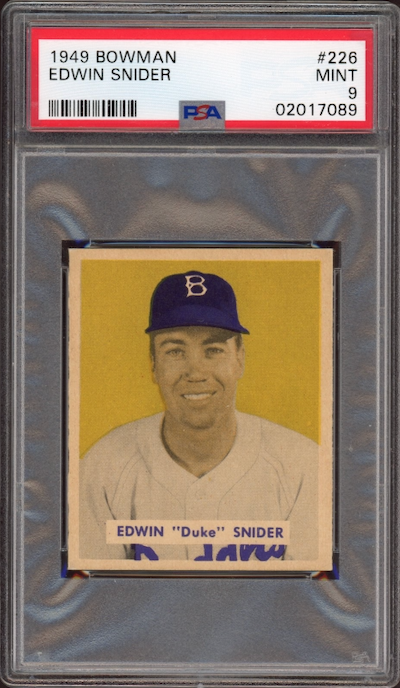
1949 Bowman #226 Duke Snider PSA MINT 9
$0.00( / )Unavailable
